Choosing Solar Post Lights for international projects requires more than comparing prices and brightness. A product that performs well in a dry garden may struggle beside a humid coastline. Battery capacity, panel efficiency, weather resistance, and installation design can change the buying decision. Global buyers need practical evidence, not attractive product photos alone.
This guide presents ten buying tips based on common sourcing concerns, product specifications, and real installation conditions. It considers lighting performance, operating temperature, charging time, materials, warranty support, and replacement parts. A useful example is a pathway receiving only four hours of direct sunlight daily. In that setting, a larger panel may matter more than decorative styling. Buyers should also verify regional voltage information, packaging quality, and applicable safety requirements before placing bulk orders.
No single model suits every climate or property. That is worth admitting. Even a well-rated light can disappoint when trees create heavy shade or winter sunlight becomes weak. Supplier claims should be checked against test reports, sample units, and clear written terms. Experienced importers often request several samples before approving a full shipment. They also inspect screws, seals, switches, and battery access, because small defects can become expensive after installation. With careful comparison, this guide helps buyers make more reliable decisions while leaving room for local conditions, honest testing, and necessary improvements.
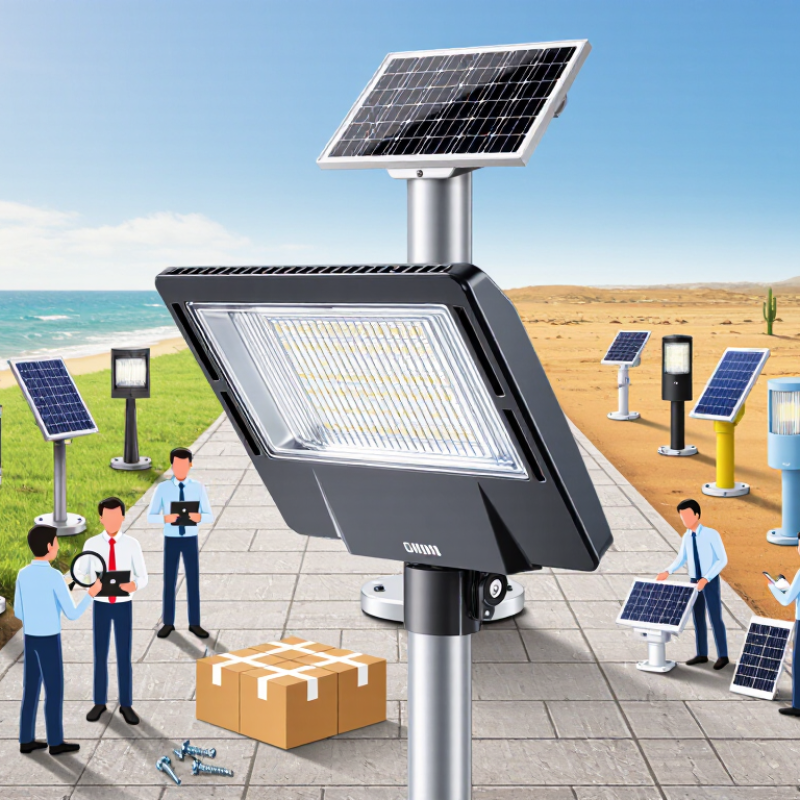
Define the post-light type before comparing prices. Integrated solar post lights combine the panel, battery, and lamp in one housing. They look clean, but repairs can be less convenient. Replaceable-panel designs allow easier battery servicing. Retrofit caps fit existing posts, though measurements must be exact.
Check post diameter, cap depth, screw spacing, and total weight. A light that fits loosely may rattle during strong wind.
Mounting choices affect stability and maintenance. A base-plate model needs a flat, solid surface and suitable anchors. A spike-mounted unit suits soil, but it may lean after heavy rain. For masonry, verify the included hardware and drilling requirements.
Tip: Measure the installation area twice.
I have seen attractive lights returned because the base covered a drainage channel. Also inspect panel direction, nearby shade, and winter sunlight.
Performance claims often assume ideal exposure.
Outdoor IP ratings need careful interpretation. IP44 protects against splashing water, while IP54 offers better dust protection. IP65 usually provides stronger protection against dust and water jets. IP67 may tolerate temporary immersion, but it does not guarantee permanent underwater use.
These ratings normally describe the enclosure, not every cable joint or mounting point. Look for testing aligned with IEC 60529, and inspect seals before installation.
More protection is not always better. A sealed housing can still suffer from condensation, poor ventilation, or a weak battery. That detail is easy to overlook.
When comparing solar post lights, start with photovoltaic output, not decorative claims. A panel rated at 15–23% efficiency can convert sunlight effectively under laboratory conditions. Real-world results vary with cloud cover, dust, heat, and installation angle. A south-facing panel may perform differently from one placed beneath tree branches. Check the panel’s wattage and measured charging current. Efficiency alone is not enough.
Runtime usually ranges from 6–10 hours after a full charge. That figure depends on battery capacity, LED brightness, and local daylight hours. A light using a small battery may reach ten hours only at reduced brightness. Ask for runtime data at the selected brightness level. Review winter performance too. In northern regions, shorter days can reduce charging time sharply. I have found that a clean panel often improves consistency more than a higher advertised rating. It is easy to overlook this detail. Compare several test conditions, including cloudy-day charging and partial shade. Also check whether the controller prevents deep battery discharge. This can influence service life and nighttime reliability. No specification is perfect. Even careful buyers may overvalue efficiency while ignoring battery storage and placement.
| Tip | Buying Dimension | Recommended Specification | Typical Data Range | Why It Matters | Global Buyer Check |
|---|---|---|---|---|---|
| 1 | PV Conversion Efficiency | Monocrystalline silicon photovoltaic panel | 15–23% | Higher efficiency can produce more electricity from the same panel area, especially when the post light has limited surface space. | Request the panel technology and rated efficiency under standard test conditions rather than relying only on wattage claims. |
| 2 | Solar Panel Rated Power | Panel power matched to the LED load and battery capacity | 1–5 W | A larger panel generally harvests more energy, but actual output depends on sunlight, temperature, orientation, shading, and system losses. | Compare the panel’s rated power with the light’s operating wattage and local solar conditions. |
| 3 | Nightly Runtime | Full-night operation after adequate daytime charging | 6–10 hours | Runtime indicates whether the light can cover an evening period and remain active until early morning. | Confirm whether the stated runtime is measured at full brightness, reduced brightness, or motion-sensor mode. |
| 4 | Battery Chemistry | Rechargeable lithium-ion or lithium iron phosphate battery | 3.2–3.7 V nominal | Battery chemistry affects energy density, operating temperature, safety, cycle life, and enclosure size. | Check the battery type, capacity in Wh or mAh, protection circuit, and replacement availability in the destination market. |
| 5 | Battery Capacity | Capacity sufficient for the LED power and local winter conditions | 1,200–4,000 mAh | More capacity can provide a larger energy reserve, although it also requires adequate solar charging time. | Ask for usable capacity and expected runtime after cloudy days, not only the nominal battery rating. |
| 6 | LED Light Output | Warm white or neutral white LED with efficient optical design | 50–250 lumens | Lumens measure visible light output and are more useful for comparison than LED wattage alone. | Compare measured lumens, beam distribution, glare control, and whether the value is initial or maintained output. |
| 7 | Color Temperature | Warm white for residential areas; neutral white for pathways and security | 2,700–4,000 K | Lower color temperatures create a warmer appearance and typically reduce visual harshness in gardens and outdoor seating areas. | Check local preferences, planning requirements, and any restrictions on light pollution or cooler white light. |
| 8 | Weather Protection | Sealed outdoor construction with corrosion-resistant materials | IP44–IP65 | Ingress protection describes resistance to solid particles and water; a higher rating generally provides better protection in exposed locations. | For coastal or snowy regions, also verify UV resistance, drainage design, salt-spray resistance, and freeze-thaw performance. |
| 9 | Operating Temperature | Temperature range suitable for the installation climate | −20°C to 50°C | Battery charging and discharge performance can decline in very cold or hot conditions, affecting runtime and service life. | Compare the tested operating and charging temperatures with the climate of the target country or region. |
| 10 | Installation and Controls | Standard post fit, automatic dusk-to-dawn sensor, and optional modes | 60–90 mm common post fit | Correct dimensions and automatic control simplify installation, reduce wiring requirements, and help conserve stored energy. | Confirm mounting diameter, included hardware, sensor sensitivity, brightness modes, switch access, and installation instructions. |
Note: Performance ranges are typical market specifications. Actual PV output and runtime vary with solar irradiance, shading, panel orientation, temperature, battery condition, LED setting, and charging losses.
10 Solar Post Lights Buying Tips for Global Buyers
Select Lumens, Beam Angles, and CCT Using IES Lighting Criteria
IES criteria do not prescribe one universal lumen value for every solar post light. They require the application to guide performance. For a pathway, begin around 100–300 delivered lumens. Wider pedestrian areas may need more. Delivered lumens matter. Not the LED package rating. IES LM-79 testing measures complete-luminaire output, while the U.S. Department of Energy reports that optics, temperature, and power systems can reduce real fixture performance.
Beam angle controls spacing and glare. A 30–60° beam creates stronger pools of light near columns or entrances. A 90–120° distribution produces softer pathway coverage. Ask for a photometric file and review the IES LM-63 format. Check average illuminance, uniformity, and spill light. A bright center with dark gaps is still poor design. I have seen buyers compare lumens alone, then discover uncomfortable shadows between posts.
CCT should match the setting. IES and dark-sky guidance generally support warmer light for residential and wildlife-sensitive areas. Choose 2200–3000K where visual comfort matters. Around 4000K can improve perceived detail, but it may appear harsh outdoors. The CIE 191:2010 report also warns that photopic lumens do not fully represent night vision. That means a lower-CCT lamp can feel brighter than its rating suggests. Battery capacity, winter weather, and shading must be checked too. A perfect specification can fail after several cloudy days.
When buying solar post lights, do not accept “50,000-hour LED life” as a complete answer. Ask the supplier for LM-80 test reports and L70 projections supporting that figure. LM-80 measures lumen maintenance for LED packages or modules under defined temperatures and drive currents. L70 estimates when light output may fall to 70 percent of its initial level. It is not a simple countdown clock.
Check whether the report matches the product’s actual LED configuration. Confirm the tested current, case temperature, light source type, and testing period. Request the related TM-21 calculation when available, because it explains how the L70 estimate was projected. A certificate with no test conditions is weak evidence. Ask questions.
Field inspections often reveal another problem. The LED may remain healthy, while the battery loses capacity after several winter cycles. Dusty panels, poor drainage, and high summer heat can also shorten usable lighting time. Therefore, compare LED evidence with battery specifications, operating temperatures, and warranty terms. The fixture’s whole system matters.
I would also request sample test data from an independent laboratory or a traceable testing facility. Supplier documents can be useful, but they deserve careful checking. A realistic claim may be more trustworthy than a perfect one. For a global purchase, keep every report, revision, and test condition in the contract file. This makes later quality discussions clearer.
Buying solar post lights globally requires more than comparing brightness and appearance. A practical audit starts with the battery. Check its chemistry, rated capacity, cycle performance, operating temperature, and date code. Confirm that the battery matches the product’s charging circuit. A large capacity number can mislead.
Request IEC 62133 test documentation for the rechargeable battery. The report should identify the cell type, battery model, test edition, laboratory, and tested configuration. Do not accept a generic certificate with no traceable details. Inspect protection against overcharge, short circuits, overheating, and deep discharge. Ask whether samples came from normal production. They should. Packaging, connectors, and sealing also deserve attention, especially for wet or freezing regions.
Warranty terms reveal the supplier’s confidence. Check coverage for battery failure, water ingress, charging faults, and reduced runtime. Look for exclusions involving temperature, installation, or neglected cleaning. A two-year warranty may be weaker than a clear replacement process with spare battery availability. Calculate lifecycle cost using battery replacements, labor, shipping, and disposal requirements. A cheaper light may need service every eighteen months. That is not cheap. Keep records of promised runtime and measured performance. Small differences matter across hundreds of units. One imperfect assumption can distort the entire purchase forecast. Ask difficult questions before the cartons leave the factory.
Battery chemistry, IEC 62133 safety evidence, warranty terms, and lifecycle-cost planning
How to read the chart: The ranges show commonly published engineering ranges for rechargeable cells used in solar lighting, with end-of-life often defined near 80% of original capacity. Actual results depend on temperature, depth of discharge, charging control, and storage conditions.